

Rapid Fire Exchange
Faculty, students, and staff put social media in the crosshairs
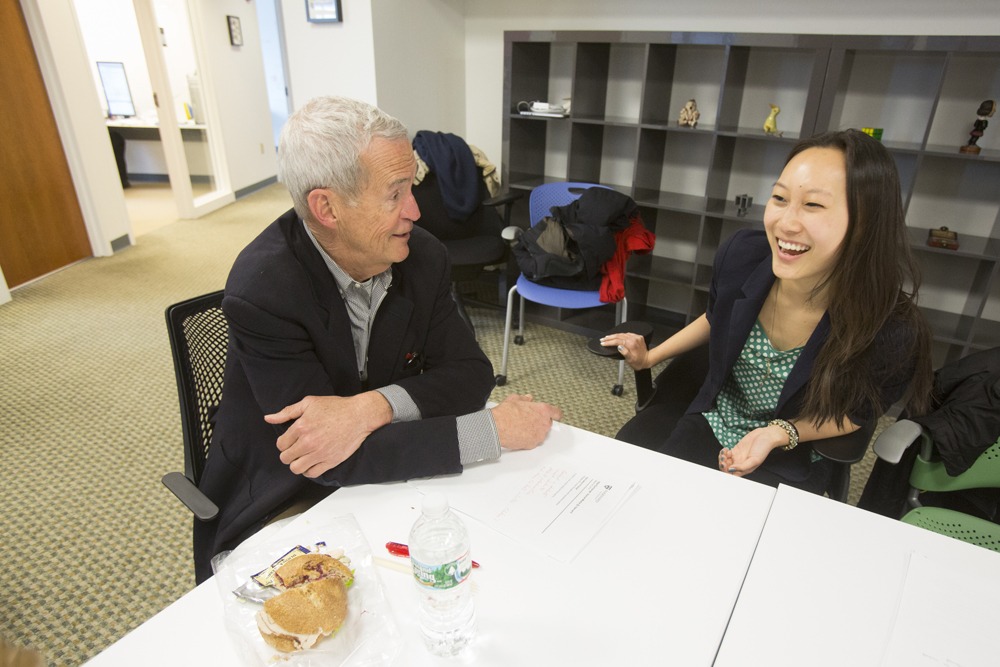
With a wry smile, Marlon Kuzmick, Associate Director of the Bok Center for Teaching and Learning, kicked off a discussion dubbed the Idea Exchange with a simple prompt: “I would like to use social media to…”
Hosted by the Office of the Vice Provost for Advances in Learning, the event on March 26th gathered faculty, staff, and students from campus to socialize about social media at Harvard. While civil in tone, the exchange began with participants throwing Kuzmick’s softball question right back at him.
For Cox and others, social media, from Twitter to Tumblr, has become a tool like any other—like a pencil that is well worn, familiar, and, in some cases, dull.
Cox, who developed a custom learning platform for his HarvardX online course “MCB80x: Fundamentals of Neuroscience,” admitted that he boasted no fewer than six Twitter handles.
Then again, Cox, who developed a custom learning platform for his HarvardX online course MCB80x, “Fundamentals of Neuroscience,” admitted that he boasted no less than six Twitter handles.
Each served a different purpose; some related to work with professional academic societies, others directed specifically at his online course, which enrolls 30,000, and still others as a means to anonymously take on pet peeves.
Jake Silberg ’15, an undergraduate with a start-up under his belt (Valet.io, a fundraising app), took the question a bit more literally, presenting a systematic tour of the social media landscape he sees on campus.
“For students, Facebook is for friends you know and Twitter is for building your professional reputation as an expert or influencer,” he said.
Instagram is somewhere in the middle, reaching broader, lesser known audiences through as-it-happens snapshots. With a camera on every phone, sharing across all platforms has becoming increasingly visual.
In fact, the right picture at the right time, like a group selfie of Oscar winners or a photo bomb with President Obama, may be worth more than a thousand words. It may be worth a million retweets or shares.
Perry Hewitt, the University’s Chief Digital Officer said that she applauds the positive power of social media to “break down silos” and integrate and disseminate rather than control information across campus. Users, however, should take heed of the often hidden risks inherent in the viral nature of online content.
The “speed-of-light” nature of a Vine video or tweet is hard to fathom in the abstract. A seemingly innocuous tweet can take on new meaning in the lightning fast news cycle, particularly when the Harvard name is appended.
Meghan Morrissey, a lead course developer at HarvardX, noted that in some cases, going viral can be the intentional end goal. She and the team behind “SW12x: China” created a YouTube sing-along-video to help students remember the order of China’s dynasties. Moreover, they intentionally catered the video to Chinese audiences, uploading it to native social media sites. And voila, the video has scored over 1 million views.
At the other extreme, Sue Goldie, Roger Irving Lee Professor of Public Health, Director, Harvard Global Health Institute, remarked that she used Twitter in a more targeted manner, to make sure her kids were not in any trouble, as she assumed that the Twitterverse would know before she would or even before the proverbial phone call.
On a more serious note, while she has used social media to aid her own global health work and to encourage students to sum up complicated arguments in a world with an attention span of 140 characters or fewer, she worries that free and open platforms may not be safe spaces, especially for groups that are disenfranchised or politically targeted.
Graduate student Carla Martin, a College Fellow on African and African American Studies, echoed Goldie’s sentiment. Nonetheless, Martin is eager to further the use of technology to help students find their voices, especially women and minorities. In fact, the seeds of “I, Too, Am Harvard”, a Tumblr-fueled campaign to raise awareness about race and belonging at elite college campuses, came partially from an exercise she ran in one of her classes.
And yet, as the small group all shared success stories about using Twitter or Facebook to promote events and causes or implementing discussion board software like Piazza to convene conversations, an undercurrent of concern swelled quietly.
Michelle Luo ’14, a computer science concentrator who has been a teaching fellow for CS50, “Introduction to Computer Science,” and an intern at Google, revealed that she limited her personal use of social media due to privacy concerns. Morrissey said the same as others nodded in agreement.
Judy Singer, James Bryant Conant Professor of Education at the Harvard Graduate School of Education and Senior Vice Provost for Faculty Development and Diversity captured the mood swing when she told the tales of all the orphaned accounts she created on then brand new social media platforms, but later abandoned.
Singer signed up for Facebook “to see what it was all about” in the days when users had to have a Harvard email address to join. She has rarely touched or visited the site since.
Goldie surmised that such reticence may come from the growing concern that there are “ethical and appropriateness issues” across all of the sites, buried in the 8pt type of legal waivers that most users agree to without much scrutiny.
Moving the conversations to safer, more controlled harbors, like custom-built tools, a longstanding strategy of some higher education institutions, including Harvard, garners protection, but also causes problems.
Michael Mitzenmacher, Thomas J. Watson, Sr. Professor of Computer Science, who runs the popular blog MyBiasedCoin and has conducted research on whether Groupons influence Yelp ratings, had one simple demand for administrators: “Do not create your own platforms! Harvard is not a software company.”
Cox put it in far simpler terms, saying, “We have to go to where the conversations are. Are we going to be part of the discussion where it is happening or try to unsuccessfully funnel them to one place?”
By the end of the hour of friendly-fire debate, the initial question--how to use social media on and beyond campus--had come full circle while still remaining open.
By the end of the hour of friendly-fire debate, the initial question, how to use social media on and beyond campus, had come full circle while still remaining open for interpretation.
Goldie got the last word, asking, “How can we use and exploit social media spaces to further conversations and yet keep these privacy security concerns in mind?”